Marriage in God’s eyes is a big deal. God created this human institution with a purpose and to plan. The strange events in Chapter 3 of the BOOK of RUTH give us but a glimpse of the seriousness of the male and female union. ♦
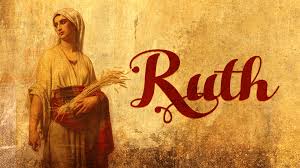
Chapter 2 ended with Ruth settling into the Hebrew community by working as a harvester gleaning the scraps of barley stalks in the fields outside Bethlehem.
She and her Jewish mother-in-law, Naomi, have traveled back to the area from Moab after being away for 10 years. In Moab, both Naomi’s husband, Elimelech, and her two sons Mahlon and Kilion, died.
Naomi and now two young Moabite widowed wives, Ruth and Orpah, had to fend for themselves.
At Naomi’s urging, Orpah returned to live with her own family in Moab. But Ruth decided to stay with Naomi and return to Bethlehem as two widows.
Naomi encouraged Ruth to work the fields and collect the grain left behind by the harvesters. This was an actual Hebrew practice outlined by God in their Mosaic Law when they first entered the Promised Land (see Leviticus 19:9-10 and Deuteronomy 24:19). It’s was actually an amazing way to provide for widows and orphans by having harvesters leave a portion of leftovers for the poor to follow behind and pick up themselves.
This was God’s natural welfare system that provided for the poor while letting them maintain self-respect and work for their provisions.
Ruth now has steady work throughout the harvest season working the field of a wealthy Jewish man named Boaz. It turns out that Boaz is a distant relative of Naomi, an important circumstance according to Hebrew law.
Naomi the Matchmaker?
Chapter 3 opens with Naomi giving very clear instructions to her daughter-in-law, Ruth, regarding Boaz. To us outside that time and culture, the instructions seem brazen and provocative, as if Naomi is pushing Ruth to find a good husband-catch, namely, Boaz, a wealthy one no less!
One day Ruth’s mother-in-law Naomi said to her, “My daughter, I must find a home for you (find security through marriage), where you will be well provided for. Now Boaz, with whose women you have worked, is a relative of ours. Tonight he will be winnowing barley on the threshing floor. Wash, put on perfume, and get dressed in your best clothes. Then go down to the threshing floor, but don’t let him know you are there until he has finished eating and drinking. When he lies down, note the place where he is lying. Then go and uncover his feet and lie down. He will tell you what to do.”
“I will do whatever you say,” Ruth answered. So she went down to the threshing floor and did everything her mother-in-law told her to do. (Ruth 3:1-6)
Ruth agrees to the strange matchmaking plan. She is to wash up, apply perfume, dress up, and go down to the barley threshing floor where Boaz will be sleeping after celebrating the harvest season.
The reason for this action by Ruth was not at all unusual for the Jewish culture at that time.
Naomi is aware of a centuries old Jewish law involving a kinsman redeemer, or male relative who, according to various laws of the Scriptures, had the privilege or responsibility to act on behalf of a relative who was in trouble, danger, or need.1
Naomi sees Boaz as a kinsman redeemer. And Boaz, an honorable Jewish man, knows it too. Nevertheless, he is startled by the evening encounter with Ruth:
When Boaz had finished eating and drinking and was in good spirits, he went over to lie down at the far end of the grain pile. Ruth approached quietly, uncovered his feet and lay down. In the middle of the night something startled the man; he turned—and there was a woman lying at his feet!
“Who are you?” he asked.
“I am your servant Ruth,” she said. “Spread the corner of your garment over me, since you are a guardian-redeemer of our family.”
“The Lord bless you, my daughter,” he replied. “This kindness is greater than that which you showed earlier: You have not run after the younger men, whether rich or poor. And now, my daughter, don’t be afraid. I will do for you all you ask. All the people of my town know that you are a woman of noble character. (Ruth 3:7-11)
But Boaz knew that there is actually another local relative who is more closely related. He informs Ruth that this other man has the right of first refusal. She complies.
Although it is true that I am a guardian-redeemer of our family, there is another who is more closely related than I. Stay here for the night, and in the morning if he wants to do his duty as your guardian-redeemer, good; let him redeem you. But if he is not willing, as surely as the Lord lives I will do it. Lie here until morning.”
So she lay at his feet until morning, but got up before anyone could be recognized; and he said, “No one must know that a woman came to the threshing floor.”
He also said, “Bring me the shawl you are wearing and hold it out.” When she did so, he poured into it six measures of barley and placed the bundle on her. Then he went back to town. (Ruth 3:12-15)
Ruth then returns home to Naomi and tells her all that transpired. The women can only wait to see what the outcome will be.
When Ruth came to her mother-in-law, Naomi asked, “How did it go, my daughter?”
Then she told her everything Boaz had done for her and added, “He gave me these six measures of barley, saying, ‘Don’t go back to your mother-in-law empty-handed.’”
Then Naomi said, “Wait, my daughter, until you find out what happens. For the man will not rest until the matter is settled today.” (Ruth 3:16-18)
God is the Matchmaker
So, no – Naomi is not playing matchmaker. She is following through on Mosaic law and the serious provisions God provides for the perpetuation of family lines.
God is the ultimate matchmaker, designing marriage between a man and a woman as a sacred, God-ordained human institution to perpetuate life and families and bring into creation lives and souls He has ordained from the beginning.
Yes, marriage is serious business in God’s domain.
As we will see in Chapter 4, the descendant offspring of this developing union of Ruth and Boaz will have an ultimate impact on all of mankind.
Do you understand God as the originator of human marriage?
_______________________________
Now Boaz, with whose women you have worked, is a relative of ours. Tonight he will be winnowing barley on the threshing floor. – Ruth 2:10
1 Note: The Hebrew term (go el) for kinsman-redeemer designates one who delivers or rescues (see Genesis 48:16 and Exodus 6:6) or redeems property or person (see Leviticus 27:9-36, 25:47-55).
Categories: Abundant Living, Biblical Character, Calling, Creation, Devotion, Discipleship, Faith, Family, Fathering, Forgiveness, Israel, Jesus, Manhood, Marketplace, Marriage, Old Testament, Purpose, Uncategorized


Leave a comment