God’s plans are not thwarted. The Bible reveals a long-term play of God’s plans for this world and mankind. A key theme is obedience. We get a further glimpse of this as this 4 chapter BOOK of RUTH closes out. ♦
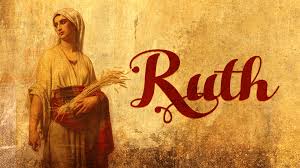
As we’ve seen in the curious BOOK of RUTH, our 2 protagonists, Naomi and Ruth, move from normal married life in Moab to coming back to Judah as poor and grieving widows.
By the end of Chapter 1, Naomi is in the depths of despair:
Do not call me Naomi, call me Mara, for the Almighty has dealt very bitterly with me. I went away full, and the Lord has brought me back empty. (Ruth 2:20-21a)
In Chapter 2, Ruth takes the initiative to work and Naomi rallies to encourage her loyal daughter-in-law, Ruth, to keep working in the field of a known past relative, a wealthy man named Boaz. Ruth obediently does what she is told.
In Chapter 3, Naomi directs Ruth to draw out her relative to step up in obedience to his obligation as kinsman redeemer, to deliver or rescue a relative from hardship. Boaz wants to respond in obedience, but as a follower of the Law, he knows his true status and that there is another man who was nearer in kinsman standing to Naomi.
Boaz and the Other Kinsman
Chapter 4 opens with Boaz seeking out the closer relative to Naomi; that is, the other potential kinsman redeemer who can legally claim Ruth as his wife. Boaz waited at the town gate to rightly address the issue headlong in the presence of multiple witnesses.
Meanwhile Boaz went up to the town gate and sat down there just as the guardian-redeemer he had mentioned came along. Boaz said, “Come over here, my friend, and sit down.” So he went over and sat down.
Boaz took ten of the elders of the town and said, “Sit here,” and they did so. (Ruth 4:1-2)
First Boaz informs the man about the opportunity to purchase (redeem) the land owned by Naomi. The man agrees to redeem it.
Then he said to the guardian-redeemer, “Naomi, who has come back from Moab, is selling the piece of land that belonged to our relative Elimelek. I thought I should bring the matter to your attention and suggest that you buy it in the presence of these seated here and in the presence of the elders of my people. If you will redeem it, do so. But if you will not, tell me, so I will know. For no one has the right to do it except you, and I am next in line.”
“I will redeem it,” he said. (Ruth 4:3-4)
Then Boaz tells the man that with the land purchase he will also acquire “Ruth the Moabite.” However, this is something that the man cannot accept.
Then Boaz said, “On the day you buy the land from Naomi, you also acquire Ruth the Moabite, the dead man’s widow, in order to maintain the name of the dead with his property.”
At this, the guardian-redeemer said, “Then I cannot redeem it because I might endanger my own estate. You redeem it yourself. I cannot do it.” (Ruth 4:5-6)
Boaz Fulfils the Legal Requirements
As specified in the Old Testament as Hebrew law (see Deuteronomy 27:5-10), there is a strange practice of giving one’s sandal to another to legalize a transaction.
(Now in earlier times in Israel, for the redemption and transfer of property to become final, one party took off his sandal and gave it to the other. This was the method of legalizing transactions in Israel.)
So the guardian-redeemer said to Boaz, “Buy it yourself.” And he removed his sandal. (Ruth 4:7-8)
Boaz completes the transaction and announces to all his witnesses that he is acquiring Ruth as his wife.
Then Boaz announced to the elders and all the people, “Today you are witnesses that I have bought from Naomi all the property of Elimelek, Kilion and Mahlon. I have also acquired Ruth the Moabite, Mahlon’s widow, as my wife, in order to maintain the name of the dead with his property, so that his name will not disappear from among his family or from his hometown. Today you are witnesses!” (Ruth 4:9-10)
The elders, as witnesses, extend blessings to Boaz and his marriage to Ruth and for their future offspring.
Then the elders and all the people at the gate said, “We are witnesses. May the Lord make the woman who is coming into your home like Rachel and Leah, who together built up the family of Israel. May you have standing in Ephrathah and be famous in Bethlehem. Through the offspring the Lord gives you by this young woman, may your family be like that of Perez, whom Tamar bore to Judah.” (Ruth 4:11-12)
Boaz and Ruth Marry – Obed is Born
So the older man, Boaz, marries the younger woman, Ruth, and God enables a child to be conceived. The event is celebrated and there is much joy for the couple, as well as for Naomi.
And Obed becomes the father of Jesse, the father of David, who would become king of Israel (born in 1040 BC).
So Boaz took Ruth and she became his wife. When he made love to her, the Lord enabled her to conceive, and she gave birth to a son. The women said to Naomi: “Praise be to the Lord, who this day has not left you without a guardian-redeemer. May he become famous throughout Israel! He will renew your life and sustain you in your old age. For your daughter-in-law, who loves you and who is better to you than seven sons, has given him birth.”
Then Naomi took the child in her arms and cared for him. The women living there said, “Naomi has a son!” And they named him Obed. He was the father of Jesse, the father of David. (Ruth 4:13-17)
And so Ruth, the Moabite, enters the Davidic Line, which as shown in Matthew 1:2-16, extends originally from Abraham, through King David, to ultimately Joseph, husband of Mary, of whom Jesus was born, who is called Christ.
This, then, is the family line of Perez: Perez was the father of Hezron, Hezron the father of Ram, Ram the father of Amminadab, Amminadab the father of Nahshon, Nahshon the father of Salmon, Salmon the father of Boaz, Boaz the father of Obed, Obed the father of Jesse, and Jesse the father of David. (Ruth 4:18-22)
An Interesting Love Story?
Yes, an interesting love story, no doubt. But also a love story at a higher level. This story is embedded in Jewish history and reveals the human intervention, even of a pagan (Ruth), who simply lives and becomes a follower of the One True God, the God of her mother-in-law, Naomi, the God of Israel.
This new allegiance and obedience to her family and God lead her to become vital to the line of David, who centuries later leads to the line of Jesus Christ, the Holy One, born of Mary, conceived by the Holy Spirit, yet through the Hebrew line of descendants beginning with Abraham over 2,000 years earlier.
And this Jesus, sometimes called the Second Adam, who like Boaz, was obedient to his purpose and role as the ultimate kinsman redeemer of all mankind, to save and restore the lost plight of man originated through the disobedience of the First Adam.
Yes, God loves, and is kind, and is good, and is righteous, and is in control of a plan presented in these Holy Scriptures as the full revelation of His nature, ways, and plans. It’s on us to seek, to follow, to understand, to obey, and to submit – like many of the characters in this BOOK of RUTH – to times, situations, hurts, losses, and trials we may not fully understand or even deserve.
But in our own Godly obedience we can know and rest on the ultimate good ending of a plan that may play out well beyond our small time in this realm and dimension. Our hope and our joy is in living a life worthy and responsive to the call that our obedience would not have us miss.
Do you now have a richer understanding of the BOOK of RUTH?
_______________________________
The women said to Naomi: “Praise be to the Lord, who this day has not left you without a guardian-redeemer. May he become famous throughout Israel! He will renew your life and sustain you in your old age. For your daughter-in-law, who loves you and who is better to you than seven sons, has given him birth. Then Naomi took the child in her arms and cared for him.” – Ruth 4:14-16
Categories: Abundant Living, Biblical Character, Books of the Bible, Calling, Devotion, Discipleship, Faith, Family, Fathering, Israel, Jesus, Manhood, Marketplace, Marriage, Parenting, People, Purpose, Suffering, Uncategorized
 Biblical Viewpoint
Leave a comment